You’ve found the perfect camper shell online or you’re ready to order a custom one, and now you’re faced with a critical step: measuring your truck bed accurately. One wrong measurement and your shell won’t fit, leading to delays, extra costs, or a complete redo. Getting the right dimensions isn’t just about length and width; it’s about precision, knowing where to measure, and understanding how your truck’s unique features impact the fit. Whether you drive a Ford F-150, Chevrolet Silverado, Toyota Tacoma, or another model, this guide walks you through every step to measure truck bed for camper shell correctly the first time.
We’ll cover how to measure length, width, and height, identify bed type, and account for wheel wells, bed rails, and tailgates. You’ll learn common mistakes to avoid, what tools you need, and how manufacturers use your numbers. By the end, you’ll have the confidence to provide exact specs, whether you’re buying from a local shop or ordering online.
Gather Your Tools Before Measuring
Accuracy depends on using the correct equipment. A flexible cloth tape might seem convenient, but it stretches and gives false readings that can ruin your order.
Essential Measuring Tools
- Steel tape measure (25 ft recommended): A rigid steel tape holds its shape for consistent results.
- Notepad and pen: Record each measurement immediately so nothing gets forgotten.
- Helper (optional but helpful): Holding the tape steady while you read improves accuracy.
- Level (optional): Ensures your truck sits on flat ground for consistent height readings.
Avoid using a laser measure unless you have experience, since small angles can distort readings on curved bed surfaces.
Identify Your Truck Bed Type First

Not all truck beds are the same. Knowing your bed style helps you interpret measurements correctly and select the right shell for your vehicle.
Standard Bed Sizes by Category
Most full-size and mid-size trucks fall into one of three bed lengths:
- Short bed: 5 to 6 feet (60–72 inches)
- Standard/Regular bed: ~6.5 feet (76–78 inches)
- Long bed: 8 feet (96 inches)
Don’t rely on labels like “short” or “long,” because manufacturers vary and model years can change dimensions slightly.
Common Bed Styles
- Fleetside (Chevy/GMC): Smooth sides and straight walls for a clean fit.
- Flareside (older Ford): Curved fenders that extend into the bed area.
- Stepside (classic trucks): Wheel wells positioned outside the bed.
- Utilimaster/Composite beds (some newer models): Non-metal construction with different mounting needs.
Most camper shells are designed for fleetside or standard steel beds. Flareside and stepside trucks often require custom-fit shells to seal properly.
Measure Truck Bed Length Accurately
Length is the most critical dimension. Measure too short and the shell won’t cover the bed; measure too long and it won’t seal properly at the cab.
Start at the Bulkhead
Measure from the inside face of the bulkhead (the wall behind the cab) to the inside edge of the tailgate when closed.
- Place the tape flat along the bed floor.
- Keep it centered and straight rather than following wheel well curves.
- Record the measurement in inches to the nearest 1/8 inch.
Some manufacturers ask for “floor length,” while others want “overall length.” When in doubt, provide both:
- Floor length: From bulkhead to tailgate (most important for fit).
- Overall length: Including any rear structures (for reference only).
💡 Pro Tip: If your truck has a rear rail or bumper overhang, don’t include it. Only measure the usable bed cavity.
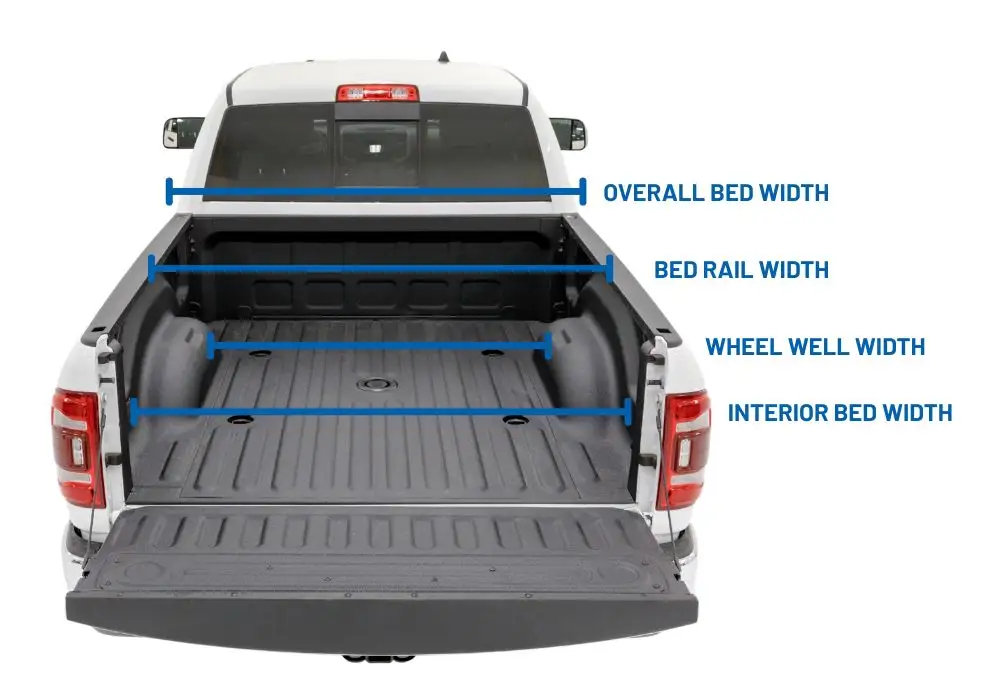
Measure Inner and Outer Bed Width

Width affects how snugly the shell fits over the rails. You need two measurements: inner width and outer width.
Inner Width at Top of Rails
Measure from the inside of one bed rail to the inside of the opposite rail, just below the lip.
- Take this measurement at three points: front, middle, and rear.
- Use the narrowest reading, since beds aren’t always perfectly square.
Outer Width at Top of Rails
Measure from the outside edge of one rail to the outside edge of the other.
- This determines shell rail coverage and clamping mechanism fit.
- Measure front, middle, and rear, and report the widest reading.
Most shells are designed to clamp over the outer rails, so outer width ensures proper mounting hardware alignment.
Check Bed Height from Rail to Floor
Height matters for shell clearance and interior headroom. Measure from the top of the bed rail down to the bed floor to ensure your shell has enough vertical space.
How to Measure Height
- Use a ruler or square to keep the tape perfectly vertical.
- Measure at all four corners and the center of the bed.
- Note the tallest point, since you don’t want the shell bottoming out on raised sections.
Most modern shells are designed for standard rail heights (typically 18–22 inches), but older or modified trucks may vary significantly.
Account for Wheel Wells and Obstructions
Even if your shell sits above the bed, internal features can affect fit and usability once installed.
Map Wheel Well Positions
- Measure distance from bulkhead to the front edge of each wheel well.
- Measure width and depth of each well.
- Note whether they are symmetrical or offset.
Some shells have interior contours that align with wheel wells. Providing these dimensions helps with fit and interior layout planning.
Check for Bed Accessories
Remove or note the position of:
- Bed liners, especially in-bed plastic types
- Toolboxes mounted along the rails
- Tie-down rails and cleats
- Bed lighting or 110V outlets
These can interfere with shell seating or clamping hardware, so manufacturers need to know about them.
Measure Tailgate and Rail Profile
The tailgate and bed rails influence how the shell seals and locks onto your truck.
Tailgate Height and Shape
- Measure height from bed floor to the top of the closed tailgate.
- Note whether it’s flat, contoured, or has an integrated spoiler.
Some shells extend slightly over the tailgate for added weather sealing.
Bed Rail Shape and Thickness
- Determine whether the rails are square, rounded, or tapered.
- Measure rail thickness (top edge width), typically 1/2 to 3/4 inch.
Clamp-on shells rely on rail shape for a secure fit. Incorrect assumptions here lead to wobbling, leaks, or poor seals.
Record the Cab-to-Bed Gap
The space between the truck cab and the bed affects how the shell seals at the front of the truck.
How to Measure the Gap
- Close the tailgate and look at the truck from above.
- Measure the horizontal gap between the back of the cab and the bed bulkhead.
- Typical range: 1/8 inch to 1/2 inch.
Also note whether the cab overhangs the bed or whether there’s a rubber seal already installed.
Manufacturers use this number to position the front cap of the shell correctly for aerodynamics and water resistance.
Take Photos and Detailed Notes
Numbers alone aren’t always enough. Supplement your measurements with visual context to help manufacturers verify fit.
What to Photograph
- Top-down view of the empty bed
- Side profile showing full bed length
- Close-ups of bed rails and tailgate
- Front bulkhead and cab gap
- Any modifications, dents, or accessories
Label each photo and match it to your written notes. This helps customer support teams confirm fit before production begins.
Double-Check All Measurements Before Submitting
One error can ruin your order. Always verify your work before sending specs to a manufacturer.
Why Re-Measure?
- Trucks aren’t perfectly square after years of use.
- Tape measures can shift during reading.
- Human error is more common than most people think.
Go through each dimension a second time, ideally with a helper. Compare results, and any difference greater than 1/4 inch needs rechecking.
Write final numbers clearly and circle them as “FINAL” before submitting your order.
Match Measurements to Manufacturer Requirements
Not all shell makers ask for the same data. Know what each brand needs before you submit.
Common Measurement Formats by Brand
- SnugTop: Requires floor length, inner/outer width, rail height, and cab gap.
- ARE: Asks for bed length, width at rail, tailgate height, and wheel well distances.
- Leer: Uses overall bed length, top inner width, rail style, and model-specific templates.
Visit the manufacturer’s website and download their specific measurement guide. Follow their format exactly to avoid delays.
When to Use a Template
Some brands provide cardboard or paper templates to trace your bed shape. Use them whenever possible, since they account for curves and contours that numbers alone can miss.
Avoid Common Measuring Mistakes
Even experienced users make errors. Stay alert and watch for these frequent pitfalls.
Top 5 Measuring Mistakes
- Measuring over the tailgate: Only measure to the inside edge when the tailgate is closed.
- Using the wrong starting point: Always begin at the bulkhead, not the back of the cab.
- Ignoring bed liner thickness: In-bed liners add 1/4 inch or more; remove them before measuring.
- Assuming symmetry: Beds warp over time, so measure both sides independently.
- Rounding too aggressively: Don’t say “6 feet”; say “72 1/4 inches” for precision.
Precision prevents returns, restocking fees, and custom fitting charges.
Consider Professional Measurement Services
If you’re unsure about your skills or tools, getting help can save money in the long run.
When to Hire a Pro
- You’re buying a high-end or fully custom shell.
- Your truck is modified, lifted, or older.
- You don’t have time to measure multiple times.
Many auto accessory shops offer measurement services for $20–$50. Some dealers include it free with purchase.
A professional will use factory specs, laser tools, and brand-specific guides to ensure accuracy the first time.
Finalize and Submit Your Dimensions
Now that you’ve measured carefully, it’s time to send your specs to the manufacturer or dealer.
What to Include in Your Submission
- Truck make, model, year, and bed length (e.g., 2021 Ford F-150, 5.5-ft bed)
- Floor length in inches
- Inner width (minimum reading)
- Outer width (maximum reading)
- Rail height (maximum reading)
- Tailgate height
- Cab-to-bed gap
- Wheel well locations measured from the bulkhead
- Photos and accessory notes
Keep a copy for your records so you can verify the shell against your original numbers when it arrives.
Frequently Asked Questions About Measuring Truck Bed for Camper Shell
What is the most important measurement when fitting a camper shell?
Floor length is the most critical dimension because it determines whether the shell covers the entire bed. Measure from the inside of the bulkhead to the inside of the closed tailgate for the most accurate result.
Should I remove my bed liner before measuring?
Yes, you should remove any in-bed plastic liner before measuring. These liners add 1/4 inch or more to your dimensions and can throw off the fit of a clamp-on shell.
Do all camper shell brands use the same measurement format?
No, each manufacturer has its own requirements. Brands like SnugTop, ARE, and Leer each ask for slightly different specs, so always download their measurement guide before submitting.
Can I use a laser measure instead of a tape measure?
A steel tape is recommended for most users. Laser measures can give distorted readings on curved bed surfaces unless you’re experienced with the tool.
How much does a professional measurement service cost?
Most auto accessory shops charge between $20 and $50 for a professional measurement. Some dealers include the service free when you purchase a shell from them.
Key Takeaways for Measuring Your Truck Bed Correctly
Measuring your truck bed for a camper shell isn’t complicated, but it demands care and attention to detail. Focus on floor length first, since it’s the most critical dimension for coverage. Always measure inner and outer width at multiple points to account for beds that aren’t perfectly square. Don’t forget to note wheel well positions, tailgate height, and the cab-to-bed gap, because each one affects how the shell seals and sits on your truck.
Your next step is simple: gather your tools, follow the steps in this guide, and record every dimension twice. Then submit your specs along with photos to your chosen manufacturer. A few minutes of precise work now will save you hours of frustration, return shipping fees, and the headache of an ill-fitting shell down the road.