Choosing the right tonneau cover starts with one crucial step: accurate measurement. Even a 1- to 2-inch discrepancy can lead to poor fit, water leaks, or operational issues. While truck manufacturers advertise bed sizes like “5.5 ft” or “6.5 ft,” these are rounded figures and often do not reflect the actual internal dimensions at rail level, where tonneau covers mount. A Ford F-150’s “6.5 ft” bed measures 78.9 inches (6’6.9″), not 78. This guide walks you through precise, step-by-step measurements so you can confidently buy a cover that fits perfectly.
You will learn how to measure length, width, and depth correctly, avoid common mistakes, and account for accessories like bed liners and RamBox systems. Whether you are installing a retractable, hard folding, or soft roll-up cover, this guide ensures a secure, weather-tight fit.
Measure Bed Length at Rail Level

Length is the most critical dimension for tonneau cover fit. Covers attach along the top of the bed rails, so measuring at rail height rather than the floor is essential for accuracy.
Why Rail-Level Measurement Matters
Tonneau covers seal against the bulkhead (the wall behind the cab) and the tailgate. If your measurement is off by even an inch, the cover may not latch properly, leaving gaps that allow water intrusion. Advertised bed lengths are rounded for marketing, but real-world specs vary by model and year. Always measure your specific truck rather than relying on manufacturer claims.
Step-by-Step Length Measurement
Follow these steps for accurate length measurement:
- Lower the tailgate fully to ensure a straight line from bulkhead to tailgate.
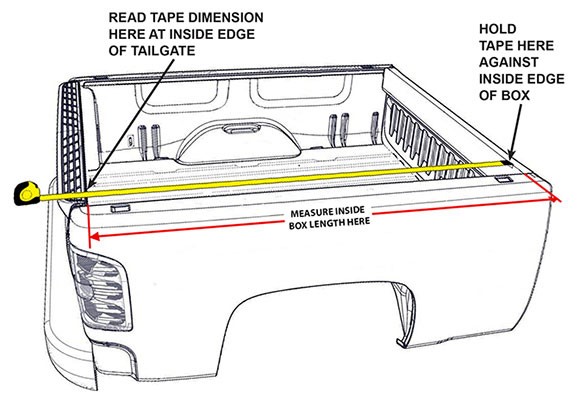
- Place the hook end of a steel tape measure flush against the inside face of the bulkhead, aligned with the top of the bed rail.
- Extend the tape straight back along the centerline of the bed to the inside top corner of the tailgate, where it meets the bed rail.
- Keep the tape taut and level. Sagging will give a false reading.
- Record the measurement in inches.
Take a photo of the tape in place. This helps when comparing specs online or contacting customer support.
Adjust for Modifications
Your truck may have modifications that affect the measurement:
- Bulkhead thickness: If measuring from the front face, subtract approximately 2.25 inches.
- Tailgate liner or mud flap: Subtract 0.5 to 1 inch if it extends inward.
- Drop-in bed liner: If it rises above the rail, measure from the top of the liner, not the metal rail.
- Bed extender: Measure with it retracted, unless you plan to use it permanently.
Convert and Match to Standard Sizes
Divide your inch measurement by 12 to get feet. For example, 67.1 inches equals 5.59 feet, approximately 5’7″. Manufacturers round to standard sizes such as 5.5′, 6.5′, and 8′. Choose the cover size closest to your measurement. Most brands allow ±1 inch tolerance, so a 78.9-inch bed fits a 78-inch or 80-inch cover.
Measure Bed Width for Rail Fit
Width ensures the cover clamps securely across the bed rails without gaps or strain on the mounting hardware.
How to Measure Accurately
- Measure from the inside top edge of one bed rail to the inside top edge of the opposite rail.
- Take two readings: one at the tailgate and one at the midpoint of the bed.
- Use the larger of the two measurements to ensure full coverage.
Some beds taper, being wider near the cab and narrower at the tailgate. Using the smaller measurement risks a loose fit. Always use the wider dimension.
Standard Width Ranges
- Midsize trucks (Tacoma, Ranger, Colorado): 44 to 50 inches
- Full-size trucks (F-150, Silverado, RAM): 50 to 52 inches
- HD models (F-250, Silverado HD): Up to 52 inches
Aftermarket rail caps or bed liners can add width. Always measure your actual setup rather than assuming standard dimensions.
Check Bed Depth for Clearance

Depth affects clearance for hard covers, accessories, and tailgate operation. This measurement helps when installing retractable or folding covers that lift or stack when open.
How to Measure Depth
- Measure from the lowest point of the bed floor to the top of the bed rail.
- Take readings at the center of the bed and over wheel wells, where the floor is higher.
- Use the deepest measurement to ensure your cover clears any humps or ridges.
Typical Depth Examples
- F-150: 21.4 inches
- Silverado 1500: 22.4 inches
- RAM 1500: 21.5 inches
- Tacoma: 20.2 to 21.2 inches
This information helps determine whether a hard folding or retractable cover will work with your bed configuration.
Use Manufacturer Charts as Reference
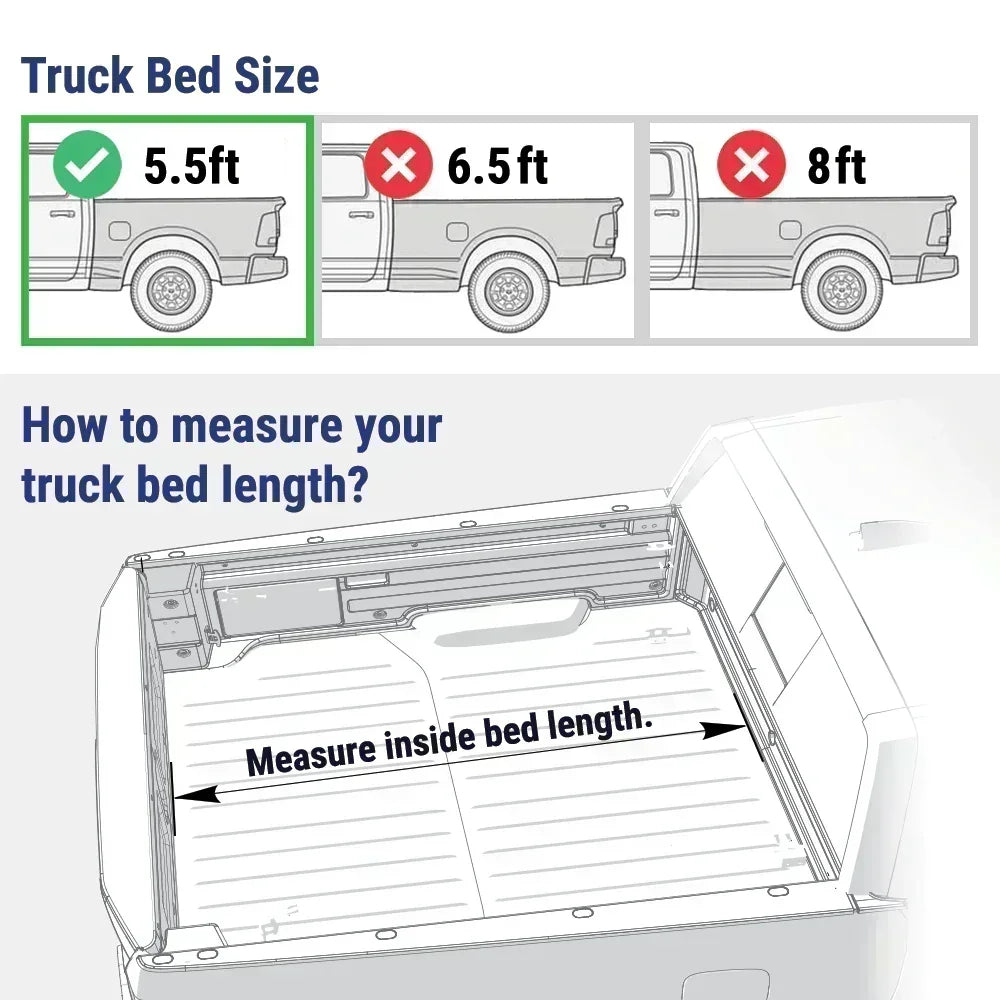
While physical measurement is essential, manufacturer charts help confirm your numbers and provide a secondary reference point.
Ford Bed Dimensions
| Model | Advertised | Actual Length (inches) |
|---|---|---|
| F-150 5.5′ | 5.5 ft | 67.1 |
| F-150 6.5′ | 6.5 ft | 78.9 |
| F-150 8′ | 8 ft | 97.6 |
| Ranger | 5 ft | 59.6 |
Some brands list F-150 6.5-foot beds as 78 inches, but the actual measurement is 78.9 inches. This falls within acceptable ±1-inch tolerance.
Chevrolet and GMC Specs
| Model | Advertised | Actual Length (inches) |
|---|---|---|
| Colorado 5′ | 5 ft | 61.7 |
| Silverado 1500 Short | 6.5 ft | 69.9 |
| Silverado 1500 Standard | 6.75 ft | 79.4 |
| Silverado HD Long | 8 ft | 98.2 |
Some brands list Silverado short bed as 68 inches, but the real measurement is 69.9 inches. Always verify with a physical measurement.
RAM Truck Bed Sizes
| Model | Advertised | Actual Length (inches) |
|---|---|---|
| RAM 1500 5’7″ | 5’7″ | 67.4 |
| RAM 1500 6’4″ | 6’4″ | 76.3 |
| RAM HD 8′ | 8 ft | 98.3 |
Standard covers do not fit over RamBox. You need a RamBox-specific model for these trucks.
Toyota Measurements
| Model | Advertised | Actual Length (inches) |
|---|---|---|
| Tacoma 5′ | 5 ft | 60.3 |
| Tacoma 6′ | 6 ft | 73.5 |
| Tundra 6’5″ | 6’5″ | 77.6 |
| Tundra 8.1′ | 8’1″ | 96.5 |
Tacoma beds vary widely between model years. Verify exact length before purchasing a cover.
Account for Truck-Specific Features
Your truck’s design impacts cover compatibility. Always check for integrated systems that may affect fit.
Ford: BoxLink and Tailgate Step
Ford trucks feature the BoxLink system with integrated tie-downs along the rails. Choose covers with BoxLink access or adapter kits. The tailgate step is common on F-150 models. Ensure the cover does not block step deployment. Bed dimensions shifted during the 2021 F-150 refresh, so measure accordingly if you have a newer model.
Chevrolet: Wide-Body and Multi-Flex Tailgate
Chevrolet Silverado models feature a wide-body design with flared bed sides that increase width. Measure carefully because some covers are too narrow. The Multi-Flex tailgate has multiple opening modes. Confirm the cover works in all configurations. The CornerStep bumper usually does not interfere, but verify clearance.
RAM: RamBox Compatibility Required
RamBox features lockable storage in the bed rails. Standard tonneau covers will not fit over RamBox. Use RamBox-specific models such as retractable or hinged covers with cutouts. Confirm the cover does not interfere with tailgate assist or sensors.
Toyota: Deck Rail and Composite Bed
Toyota trucks feature the Deck Rail system with integrated tie-down channels. Choose covers that allow access or include adapters. The composite bed material is more dent-resistant. Use non-drilling clamps to avoid damage. Some Tacomas have non-standard lengths, so measure precisely.
Avoid Common Measurement Mistakes
Even small errors can lead to a bad fit. Steer clear of these frequent missteps.
Measuring from Outside of Tailgate
This adds 2 to 3 inches, leading to an oversized cover. Always measure to the inside edge where the tailgate meets the rail.
Measuring at Bed Floor Instead of Rail
The floor is often lower than the rail, especially with deep beds or liners. This gives a longer reading and causes misalignment when installing the cover.
Ignoring Bed Accessories
Rail caps add thickness and change clamp fit. Drop-in liners raise the floor and may require raised clamps. Spray-on liners usually do not affect fit but can impact sealing. Account for all accessories before measuring.
Relying Only on Advertised Size
A “6.5 ft” bed does not mean 78 inches. Always verify with a physical measurement of your specific truck.
Not Measuring Twice
A single error can cost you time and money. Double-check every dimension and verify with a second person if possible.
Consider Accessories That Affect Fit
Add-ons like toolboxes or hitches change how a cover installs and functions.
Toolboxes
Toolboxes reduce usable bed length. They may require a shortened cover or cutout design. Confirm clearance with the cover manufacturer before purchasing.
Ladder Racks
Ladder racks can prevent full closure of the cover. Look for racks designed for use with tonneau covers if you need both accessories.
Fifth-Wheel or Gooseneck Hitches
These require removable or hinged covers. Some models have removable center sections or flip-up panels. Ensure the cover clears the hitch when open.
Cargo Management Systems
These may conflict with mounting clamps. Confirm clearance before purchase to avoid compatibility issues.
Measure for Other Bed Accessories
Your tonneau cover is not the only accessory that needs precise sizing.
Truck Caps and Toppers
Measure length at rail level (same as tonneau). Measure width from outside edge to outside edge of rails. Measure cab height at rear window for roofline alignment.
Tool Boxes
Measure width between wheel wells. Measure bed depth for height clearance. Confirm compatibility with your tonneau cover.
Bed Liners and Mats
Measure length at bed floor from bulkhead to tailgate. Measure width between wheel wells. Measure depth from highest floor point to rail top.
Frequently Asked Questions About Measuring Truck Beds
How accurate do measurements need to be?
Aim for quarter-inch precision. High-tolerance covers such as retractable and hard folding models are sensitive to variances. Even small errors can affect the seal and operation.
Can I use manufacturer specs instead of measuring?
Manufacturer specs are helpful reference points, but physical measurement is best, especially for modified or older trucks. Specs may not account for accessories or model-year changes.
Should I measure at bed floor or rails?
For tonneau covers, measure at bed rails. For bed liners and mats, measure at bed floor. This distinction is critical for getting the right fit for each accessory type.
Do bed sizes change between model years?
Yes. Redesigns such as the 2021 F-150 refresh can alter dimensions. Always verify with current data or direct measurement rather than assuming consistency.
What if my measurement does not match any cover size?
Most brands allow ±1 inch tolerance. Choose the closest match and confirm with the manufacturer. Contact customer support with your make, model, year, and exact measurements if unsure.
Key Takeaways for Measuring Your Truck Bed
Accurate measurement is the foundation of a proper tonneau cover fit. Measure at rail level rather than the floor, and always measure your specific truck rather than relying on advertised sizes. Take length measurements from the inside of the bulkhead to the inside of the tailgate, and use the larger of two width readings to ensure full coverage.
Account for all modifications including bed liners, rail caps, and accessories. Check manufacturer charts as a secondary reference, but verify everything with a physical measurement. For trucks with RamBox, BoxLink, or other integrated systems, choose compatible cover models.
Keep your original packaging until you have tested the cover in rain and at highway speeds. If you are unsure about any aspect of measurement or installation, contact the manufacturer with your exact specifications. Professional installation is recommended for complex setups including RamBox, fifth-wheel hitches, or custom configurations. Measure with confidence and drive with peace of mind knowing your cargo is protected.