You may have a 500-pound rolling cabinet wedged in your truck bed with no clear plan to get it out. Maybe the toolbox is bolted down, rusted in place, or just too awkward for one person to handle alone. The good news is that experienced DIYers and mechanics have tackled this exact problem, and there are reliable methods that work for nearly every situation.
This guide walks you through seven proven removal techniques, the tools each one requires, and the safety steps you can’t afford to skip. By the end, you’ll know which method fits your toolbox, your truck, and your budget.
Assess Your Toolbox Before Lifting a Finger
Identify the Type and Weight You Are Dealing With
Two main toolbox types show up in truck beds, and each requires a different approach:
- Rolling tool cabinets: Large, industrial-style cabinets on casters, often sitting on a wooden pallet.
- Crossbed toolboxes: Metal boxes bolted or clamped across the bed rails behind the cab.
An empty rolling cabinet can weigh 200 to 300 lbs. Fully loaded with tools, it often exceeds 500 lbs. Crossbed toolboxes usually weigh 100 to 200 lbs empty but become unwieldy because of their shape and mounting hardware.
Inspect the Mounting Setup
For crossbed toolboxes, check how the unit is secured:
- J-hooks or clamps gripping the bed rails
- Bolts through the truck bed floor
- A combination of both
For rolling cabinets, look for:
- A wooden pallet base
- Support blocks under the wheels
- Wheel locks or brakes
Knowing the setup helps you decide whether to roll, lift, or partially dismantle the toolbox before removal.
Empty the Toolbox and Reduce the Load
Remove Every Tool and Loose Item
This step is non-negotiable. A full set of tools can add 200 or more pounds and increases the risk of shifting weight or internal damage during movement.
Pro Tip: Label each drawer before removal so you can reassemble the cabinet quickly later.
Take Out the Drawers on Rolling Cabinets
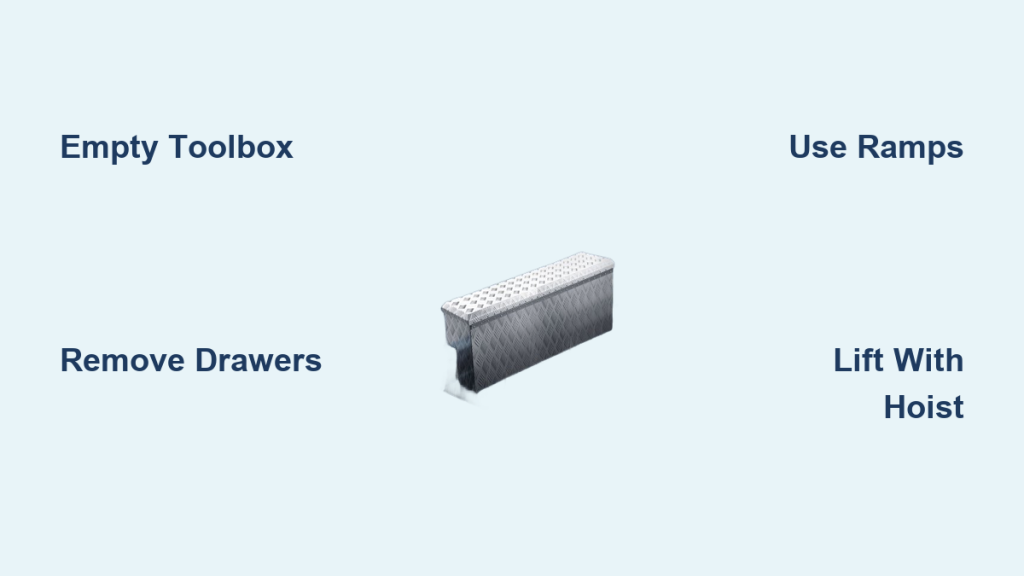
Removing drawers is one of the fastest ways to cut weight:
- Pull each drawer all the way out until it stops.
- Press down on the plastic release levers inside the runners on both sides.
- Slide the drawer free.
The cabinet is now significantly lighter and safer to handle. Store drawers on cardboard to prevent scratches.
Lock or Inspect the Casters
Most rolling cabinets have swivel casters, and many only lock one set at a time. Position the locked-wheel end forward when rolling down ramps. Verify that all wheels spin freely and are not seized by rust or debris.
Method 1: Use Ramps for Rolling Cabinets
Choose Ramps Rated for the Load
Standard Harbor Freight ramps rated at 1,500 lbs per pair are a popular, budget-friendly choice. One common issue: the factory chains are too short to reach the eye hooks on most truck beds.
Fix: Replace them with two 1-foot extension chains and S-hooks. The upgrade costs under $20 and takes minutes.
Knock Out the Pallet Support Blocks
Many rolling cabinets sit on a pallet with wooden blocks wedged under the wheels. To free the wheels:
- Tip one end slightly with a helper.
- Use a sledgehammer to knock the block loose.
- Gently lower that end onto the pallet.
- Repeat for the center and opposite end.
The cabinet now rests fully on its wheels.
Roll the Cabinet Off the Truck
- Lift the empty cabinet slightly (it is much lighter without drawers) and roll it off the pallet, ideally toward the front of the bed.
- Pull the pallet out of the truck.
- Set the ramps at the tailgate and make sure they are fully seated.
- Guide the cabinet slowly down the ramp, controlling speed by hand.
Start with the locked-wheel end first so the rolling direction is predictable.
Method 2: Rent a U-Haul Trailer
Why a Trailer Makes the Job Easier
A 6×9 U-Haul trailer with a drop-down tailgate ramp lowers the height gap between the truck bed and the ground. This reduces the ramp angle and makes rolling heavy cabinets far safer.
A daily rental costs around $29, which is often cheaper than buying ramps or lifting equipment.
How to Use the Trailer
- Back the trailer close to your truck or position it alongside the bed.
- Open the drop-down tailgate ramp.
- Roll or slide the cabinet directly from the truck onto the trailer.
- Lower the ramp and roll the cabinet to the ground.
This method works well for solo operators or anyone without ramps on hand.
Method 3: Control the Descent With a Ratchet Strap

Best for Solo Operators
If you have a headache rack or another solid anchor point at the front of the bed, a ratchet strap gives you a reliable braking system.
- Attach one end of the ratchet strap to the front of the toolbox.
- Connect the other end to the headache rack.
- Position ramps at the tailgate.
- Slowly release the ratchet as the cabinet moves down the ramp.
The internal friction of the ratchet acts like a brake and keeps the load under control without a second person.
Safety Reminders
- Never let the strap go slack during the descent.
- Confirm the anchor point is rated for the load.
- Maintain tension until the cabinet is fully on the ground.
Method 4: Lift With a Cherry Picker
The Safest Option for Heavy Loads
A cherry picker (engine hoist) rated for 1 to 2 tons lifts the toolbox vertically. This eliminates ramps, angles, and the risk of a runaway roll.
Steps to follow:
- Position the hoist at the tailgate or side of the truck.
- Wrap lifting straps around the cabinet’s sturdiest points, never the drawers.
- Lift straight up and clear of the bed.
- Swing the boom away from the truck.
- Lower the cabinet gently to the ground.
Rent a cherry picker for $50 to $100 per day if you do not own one. It is one of the most popular recommendations among experienced forum users.
Note: “Don’t do anything you can’t reverse, never get between something heavy and gravity, and a cherry picker is really handy.”
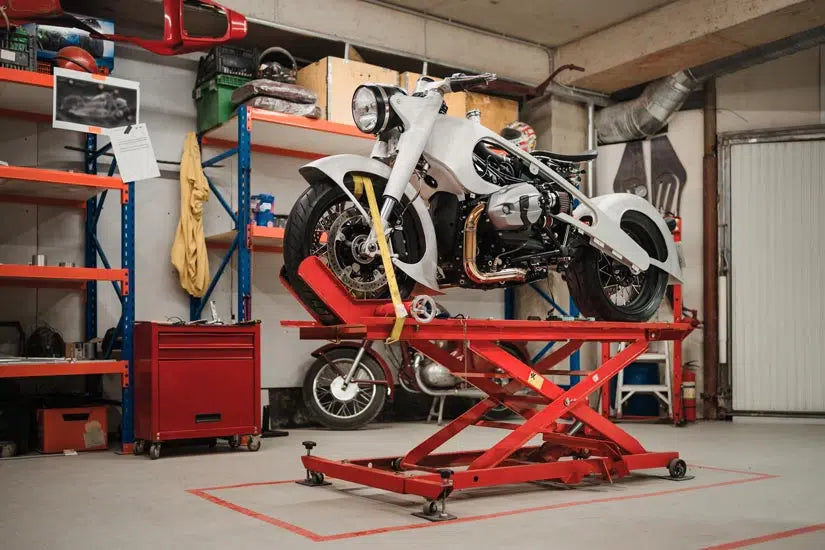
Method 5: Use a Motorcycle Lift or Hydraulic Table
Controlled Vertical Transfer
Both devices raise to truck bed height and let you roll the cabinet straight across:
- Motorcycle lift: Capacity of 1,000 to 1,500 lbs. Roll the cabinet on, then lower to the ground.
- Hydraulic table: Typically rated around 500 lbs. Great for workshop use after removal.
Steps:
- Position the lift or table next to the tailgate.
- Raise it to match bed height.
- Roll the cabinet across.
- Lower and move it to its final spot.
This approach is ideal for repeated moves or tight workspaces.
Method 6: Floor Jack and Tie-Down (Advanced)
For Experienced DIYers Only
One user successfully moved a 64-inch Matco toolbox using only a floor jack and a ratchet tie-down.
Technique:
- Slide the jack under one end of the cabinet.
- Lift slightly to relieve weight on the truck bed.
- Use the tie-down to stabilize and guide the cabinet.
- Walk the cabinet toward the tailgate by lifting and sliding one end at a time.
- Repeat on the opposite end.
This method carries higher risk and is best for lighter, empty cabinets and confident hands.
Method 7: Use Heavy Equipment
When You Have Access to a Loader or Forklift
If you are on a farm or job site, a front-end loader, 3-point hitch lift, or forklift can finish the job in minutes.
- Attach straps or forks to the toolbox base.
- Lift the unit straight off the truck bed.
- Carry it to the destination and lower gently.
Rental rates run $200 to $500 per day, which is worthwhile for very large cabinets or multiple moves.
Remove Mounted Crossbed Toolboxes
Identify the Mounting Hardware
Crossbed toolboxes do not roll. They are fastened with J-hooks, bolts, or both.
Loosen the Fasteners
- For J-hooks: Loosen the wing nuts or bolts under the bed rails.
- For bolts: Remove them from beneath the truck bed with a socket wrench.
- For sealant: Some installations use weatherproof caulk. Cut through it with a utility knife if needed.
Lift the Toolbox Off With Help
Even empty, crossbed toolboxes are awkward. Use two people, one on each side, and lift straight up. For heavier units, use a cherry picker for solo removal.
Troubleshoot Common Removal Problems
Toolbox Will Not Fit Through the Tailgate
- Measure the cabinet width against the tailgate opening.
- Rotate the toolbox 90° to find better clearance.
- Remove the tailgate entirely for full access.
Ramps Are Too Steep
- Switch to longer ramps to reduce the angle.
- Add boards to extend ramp length temporarily.
- Use a U-Haul trailer for a gentler slope.
Rusted or Stripped Bolts
- Apply penetrating oil such as PB Blaster or WD-40 and wait at least 30 minutes.
- Tap fasteners gently with a hammer to break corrosion.
- Use a bolt extractor or drill out the fastener as a last resort.
Cabinet Is Too Heavy
- Remove the drawers and contents first.
- Switch to a hoist or forklift.
- Recruit more help for the descent.
Protect the Toolbox, the Truck, and Yourself
Prevent Scratches and Damage
- Place cardboard under the drawers and cabinet base.
- Lay blankets in the truck bed to protect paint.
- Lift or roll the toolbox. Never drag it.
Wear the Right Safety Gear
- Work gloves for grip and pinch protection
- Safety glasses for debris or falling objects
- Steel-toed boots in case of dropped tools or wheels
Never Position Yourself Under the Load
Gravity wins every time. Keep hands, feet, and body clear of the path between the toolbox and the ground. Use blocks or lifting equipment for support, not your body.
Compare Removal Methods at a Glance

| Method | Best For | Solo-Friendly | Estimated Cost | Risk Level |
|---|---|---|---|---|
| Ramps | Rolling cabinets | No (2+ people) | $50–$100 | Medium |
| U-Haul Trailer | No ramps available | Yes | ~$29/day | Low |
| Ratchet Strap + Ramps | Solo control | Yes | $20–$50 | Medium |
| Cherry Picker | Heavy loads | Yes | $150–$400 | Very Low |
| Motorcycle Lift | Workshop use | Yes | $200–$500 | Low |
| Floor Jack | Light cabinets | Yes | $50–$150 | High |
| Hydraulic Table | Controlled lift | Yes | $200–$600 | Low |
| Loader or Forklift | Industrial jobs | Yes | $200+/day | Low |
Frequently Asked Questions About Removing a Toolbox from a Truck Bed
What Is the Easiest Way to Remove a Toolbox from a Truck Bed?
The easiest method depends on the toolbox type. For rolling cabinets, ramps paired with a ratchet strap give excellent control. For mounted crossbed toolboxes, simply unbolting the hardware and lifting with a helper is usually fastest. A cherry picker is the easiest option for very heavy units because it does all the vertical lifting for you.
Can One Person Remove a Toolbox from a Truck Bed?
Yes, but only with the right equipment. A cherry picker, motorcycle lift, or hydraulic table allows one person to safely remove a heavy toolbox without assistance. Ramps alone are not recommended for solo work because controlling a 500-pound cabinet downhill is risky.
How Much Does a Typical Truck Bed Toolbox Weigh?
An empty crossbed toolbox weighs roughly 100 to 200 lbs. A rolling tool cabinet ranges from 200 to 300 lbs empty and can exceed 500 lbs when fully loaded with tools. Always weigh or estimate the load before choosing a removal method.
Do I Need to Remove the Drawers Before Moving a Rolling Tool Cabinet?
Yes, removing the drawers is strongly recommended. Drawers can add 200 or more pounds, and they may slide open during movement, causing a dangerous shift in weight. Removing them also prevents internal damage to the cabinet and its contents.
What Tools Do I Need to Remove a Crossbed Toolbox?
Most crossbed toolboxes are removed with basic hand tools. You typically need:
- A socket wrench or ratchet set
- An adjustable wrench for older J-hooks
- A utility knife to cut through any weather sealant
- Penetrating oil for rusted fasteners
- A second person to help lift the toolbox off
How Do I Remove a Toolbox Without Damaging My Truck Bed?
Protect the truck bed by laying cardboard or moving blankets in the area before removal. Avoid dragging the toolbox across the paint. Lift it straight up or roll it on its casters. For bolted installations, slide a piece of cardboard under the toolbox while loosening fasteners to prevent scratches.
Key Takeaways for Removing Your Truck Bed Toolbox
Removing a toolbox from a truck bed does not have to be a back-breaking chore. Empty the toolbox completely and remove the drawers to cut weight fast. Choose a method that matches the toolbox weight, your available equipment, and whether you have a helper. A cherry picker offers the lowest risk for heavy cabinets, while ramps with extended chains work well for two-person teams on a budget.
Pick the method that fits your situation, gather your equipment, and clear the path before you begin. With the right plan, you can move your toolbox safely, protect your truck, and avoid injury on the first try.