
Starting a pressure washing business often means deciding between a trailer or a truck bed system. A well-planned truck bed pressure washer setup offers a smart middle ground: less upfront investment, full mobility, and room to grow. With the right tanks, pumps, and skid platform, your pickup becomes a mobile cleaning station ready for residential and light commercial work.
In this guide, you’ll learn how to size tanks, choose between DIY and pre-built skids, build a reliable chemical delivery system, and follow best practices for daily operation. Whether you’re washing two houses a day or adding weekly commercial clients, this breakdown will help you design a setup that balances cost, capacity, and long-term durability.
Size Your System for Real Workloads
Plan for 2+ Residential Jobs Daily
Start by matching your setup to your actual job volume. Most new operators aim for two residential house washes per day, which shapes tank and pump sizing. Each house typically uses 5–7 gallons of chemical solution when downstreaming, so a 15-gallon tank supports 2–4 jobs before refilling.
Plan for occasional commercial work too. Add one commercial job per week, like a fast food drive-thru, and your chemical and water demands jump significantly. Sizing your system with a little headroom prevents mid-job shortages and keeps you ready for last-minute opportunities.
Choose Between DIY and Pre-Built Skids
You have two main paths: build it yourself or buy a pre-engineered system. A DIY truck bed setup with a 4 GPM belt drive pressure washer and basic tanks keeps startup costs low while you test the market.
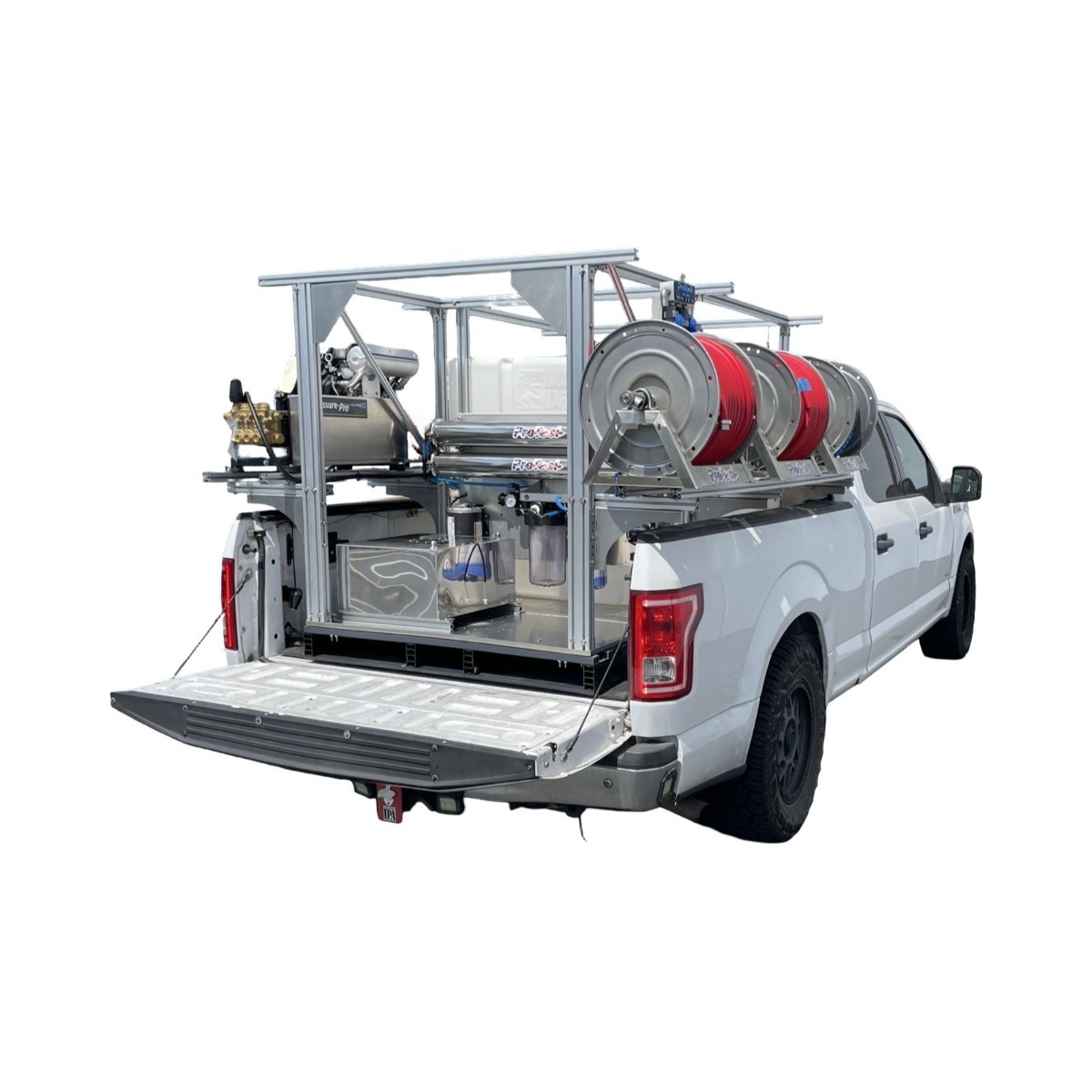
If you’re serious about scaling, a professional skid system like the Workhorse offers plug-and-play reliability, better weight distribution, and integrated components. Skids mount securely in the bed, protect your truck from vibration damage, and combine pumps, tanks, reels, and wiring into one cohesive unit.
Optimize Chemical Tank Capacity
Use 15-Gallon Tanks for Residential Work
A 15-gallon SH drum is the practical sweet spot for most residential operators. It holds enough solution for multiple houses, fits easily in an 8-foot bed, and pairs well with batch mixing.
Keep these weight and handling facts in mind:
- A full 15-gallon drum weighs 160 pounds
- Manual handling is difficult; mount it low and centered for stability
- Pre-mix at 1 oz of surfactant per gallon of SH (Elemenator works well)
- Stir thoroughly before use to ensure even blending
Avoid dish soap as a surfactant. It lacks cleaning power and can leave residue or damage seals over time.
Upgrade to 35-Gallon for Commercial Jobs
When work includes large driveways, asphalt shingles, or commercial properties, 15 gallons runs out fast. Step up to a 35-gallon chemical tank for extended runtime and fewer refills.
For maximum flexibility, carry a 5-gallon backup pail for spot treatments, rust remover, or degreaser applications. If you use multiple chemical types, keep them in separate tanks to prevent cross-contamination and protect equipment.
Build a Reliable Chemical Delivery System

Avoid Dual Port Injectors
Many beginners want to switch between lemon and cherry soaps using a dual port injector. Unfortunately, these units are prone to check valve failure, which causes chemical backflow, inconsistent mixing, and pump damage. Skipping dual injectors entirely eliminates twice the failure points and simplifies maintenance.
Use a Y-Barb Fitting for Dual Chemicals
For a simpler, more reliable setup, install a Y-barb fitting such as the FitQuik Polypropylene Union (1/4″ ID, around $0.64 from windowcleaner.com). This splitter connects two chemical lines to a single downstream injector. Just close one inline ball valve when switching chemicals.
This approach is cheap, durable, and removes the weak links found in dual injector setups. Use quality ball valves to control flow and prevent cross-contamination between chemicals.
Test Downstreaming for Commercial Chemicals
Verify Chemical Effectiveness at Dilution
Not all chemicals work well when downstreamed. Commercial degreasers and sanitizers often lose potency at the 10:1 to 20:1 dilution ratios typical of truck systems. Before relying on downstreaming, test the chemical on a small area.
If results are weak, switch to low-dilution application methods like 12V sprayers or pump-up tanks. These deliver concentrated product directly to the surface, which is critical for greasy drive-thrus or heavily soiled concrete.
Match Application Tools to Job Type
| Job Type | Best Application Method |
|---|---|
| Standard residential houses | Downstreaming from truck tank |
| Spot treatments | Pump-up sprayer |
| Large drive-thrus | 12V electric sprayer |
| Roof cleaning | Pro Mixer XL with proportional valves |
For high-volume commercial work, consider a Remco Dual Control 12V pump (5.3 GPM at 100 PSI). It’s USA-made with Viton seals for chemical resistance. Pair it with a Pro Mixer XL system for precise dilution control and reliable reach on tall structures.
Explore New Injector Technology
BULLETPROOF DS Injector (Coming Soon)
A next-generation BULLETPROOF DS Injector is in development, designed for custom two-step guns. Early testing shows it pulling 81 oz of chemical at 4.75 GPM, achieving roughly a 7.5:1 ratio.
This could improve consistency and reliability in chemical feed systems, though final specs and pricing are still pending. It’s worth watching for operators who depend on precise downstreaming.
Invest in a Professional Skid System

The Workhorse Skid: All-in-One Solution
For serious operators, the Workhorse Skid from Expert Power Wash delivers unmatched integration. Priced at $22,429, it ships as a complete mobile cleaning station engineered for daily commercial use. Choose between 6.5-foot and 8-foot models to fit most full-size truck beds.
Built with 1/4-inch thick reinforced aluminum, the Workhorse supports heavy machines on side shelves and includes a lifetime warranty. Every component is selected for performance and longevity.
Key Features of the Workhorse
- 8 GPM Honda GX690 pressure washer (belt or gear drive)
- Dual 100-gallon tanks: one for water, one for bleach
- Optional third tank: add 100 gallons for $595
- Three manual aluminum reels: 18″ and 12″ configurations
- Electric reel upgrade: $1,800 with USA-made wiring
- Remco 12V soft wash pump: 5.3 GPM with Viton seals
- Pro Mixer XL: proportional metering for precise dilution
- Fierce Jet 1/2″ hose: 200 feet with crimped NPT fittings
- Marine-grade battery: built for daily recharging
- Hudson float valve: auto-fill when water runs low
Why the Workhorse Stands Out
- 316 stainless steel hardware (upgraded from 304) for corrosion resistance
- Kuri Tec poly braid plumbing rated for high pressure and chemicals
- 95% USA-sourced components
- Free 2-day training class ($399 value) included
- Optional hands-on pickup training with Tim at the Oregon City shop
Customers report zero issues after two seasons of hard use. One verified buyer said, “The training alone was worth it.” Another noted, “You can tell every part was chosen with care.”
Organize for Efficiency and Safety
Clean and Upgrade Your Service Truck
A cluttered truck slows you down and increases injury risk. Every few months, perform a deep clean and reorganization:
- Remove expired parts and outdated manuals
- Replace old toolboxes with modular storage bins
- Label drawers and shelves for quick access
- Install LED lighting in the cargo area
Add small convenience upgrades like a mini fridge for drinks and wipes. A clean, organized truck reduces stress, improves job readiness, and presents a professional image to clients.
Mount Equipment on a Sturdy Base
Always Use a Skid or Frame
Never place pressure washers or tanks directly in your truck bed. Vibration and shifting loads damage bed liners and create safety hazards. Instead, use a skid or custom frame to mount all equipment.
Key benefits include:
- A stable platform for safe operation
- Even weight distribution across the bed
- Easy removal for maintenance or resale
- Protection for your truck bed over time
The Workhorse Skid includes ladder racks, side shelves, and an optional locking surface cleaner rack ($950 add-on), giving every item a dedicated place.
Manage Weight and Balance
Distribute Load Evenly in the Bed
A full 15-gallon SH drum weighs 160 lbs. Two 100-gallon water tanks weigh 1,660 lbs combined. That’s serious weight to manage in a truck bed.
Best practices for weight management:
- Place heaviest items over or ahead of the rear axle
- Avoid overhanging loads that stress the tailgate
- Use recessed tank bottoms (like on the Workhorse) for flush plumbing and lower center of gravity
- Stay within your truck’s GVWR limits
Improper distribution affects handling, braking, and fuel economy. Always verify your load before heading to a job.
Follow Best Practices for Daily Operation
Mix Chemicals Correctly
Stick to the 1 oz surfactant per gallon of SH rule. Use a high-quality surfactant like Elemenator. Dish soap doesn’t emulsify oils properly and can leave residue or damage seals. Pre-mix in a batch tank and stir thoroughly before filling your main tank for consistent cleaning power.
Rinse the System After Use
Extend pump life by rinsing chemical lines after every job. The Workhorse includes a 3-way bleach rinse valve that flushes the entire system with fresh water. This prevents corrosion, clogs, and seal degradation. Make it a habit, just like shutting off the machine at the end of the day.
Use the Right Hose and Fittings
Low-quality hoses kink, leak, and fail under pressure. The Workhorse uses 1/2-inch Fierce Jet Soft Wash Hose with crimped NPT fittings, eliminating threaded adapters that loosen over time. Pair it with a ST-510 gun and stainless J-rod for durable, clog-resistant spraying.
Invest in quality plumbing throughout:
- Kuri Tec hoses for soft wash lines
- Banjo fittings for secure connections
- 316 stainless clamps for corrosion resistance
Maximize Value and Support
Get Training and Manufacturer Support
A pressure washer setup is only as good as your knowledge. The Workhorse includes a $399 training credit and a free hands-on pickup session with Tim in Oregon City. You’ll learn how to operate and maintain all systems, mix chemicals correctly, and troubleshoot common issues.
Even after purchase, Expert Power Wash offers ongoing support, unlike many competitors. With distribution in 24 states, Canada, and overseas, help is never far away.
Understand Pricing and ROI
| Item | Cost |
|---|---|
| Workhorse Skid | $22,429 |
| Electric Reel Upgrade | $1,800 |
| Extra 100-Gal Tank | $595 |
| Whisper Wash 19″ | $850 |
| Locking Rack | $950 |
The upfront cost is significant, but the lifetime warranty, USA-built quality, and included training make it a long-term investment. Many users report earning back the cost in under a year with consistent commercial work.
Frequently Asked Questions About Truck Bed Pressure Washer Setups
What size chemical tank do I need for residential pressure washing?
A 15-gallon SH tank is the standard recommendation for residential work. It holds enough solution for 2–4 houses and fits easily in an 8-foot truck bed. Upgrade to a 35-gallon tank if you handle larger driveways, asphalt shingles, or weekly commercial jobs.
Are dual port injectors reliable for truck bed setups?
Dual port injectors are prone to failure due to inadequate check valves, which cause chemical backflow and pump damage. A Y-barb fitting (like the FitQuik Polypropylene Union) is a simpler alternative that eliminates extra failure points and costs around $0.64.
How much does a professional truck bed skid system cost?
The Workhorse Skid from Expert Power Wash is priced at $22,429. This includes the Honda GX690 pressure washer, dual 100-gallon tanks, Pro Mixer XL, Remco 12V pump, 200 feet of hose, and a lifetime warranty. Optional upgrades include an electric reel ($1,800) and a third 100-gallon tank ($595).
Can I downstream commercial chemicals like degreasers?
Not always. Some commercial chemicals lose effectiveness at the 10:1 to 20:1 dilution ratios typical of truck systems. Test each chemical on a small area first. If results are weak, use a 12V sprayer or pump-up tank to apply concentrated product directly.
What surfactant should I use with sodium hypochlorite?
Use a professional surfactant like Elemenator at a rate of 1 oz per gallon of SH. Avoid dish soap, as it doesn’t emulsify oils properly, leaves residue, and can damage pump seals over time.
Is the Workhorse Skid worth the investment for a new business?
For operators planning to scale into commercial work, yes. The Workhorse includes a lifetime warranty, free 2-day training ($399 value), and 95% USA-sourced components. Customers report earning back the cost in under a year and experiencing zero issues after two seasons of heavy use.
Key Takeaways for Building a Reliable Truck Bed Pressure Washer Setup
A well-designed truck bed pressure washer setup balances cost, capacity, and reliability. Start small if needed, but always plan for growth. Use 15-gallon tanks for residential work, upgrade to 35-gallon or dual 100-gallon systems for commercial jobs, and avoid unreliable components like dual injectors.
For maximum efficiency, consider a pre-built skid like the Workhorse, engineered for durability, ease of use, and professional results. Invest in quality hoses, fittings, and surfactants, and rinse your lines after every job to extend pump life.
Your next step: Map out your expected job volume for the next 6 months, then size your tanks and pump accordingly. If you anticipate commercial work, start saving toward a pre-built skid or build your own system with chemical-resistant components from day one.